
GZCL P-Zero · Shoulders
By Cody Lefever · With Permission
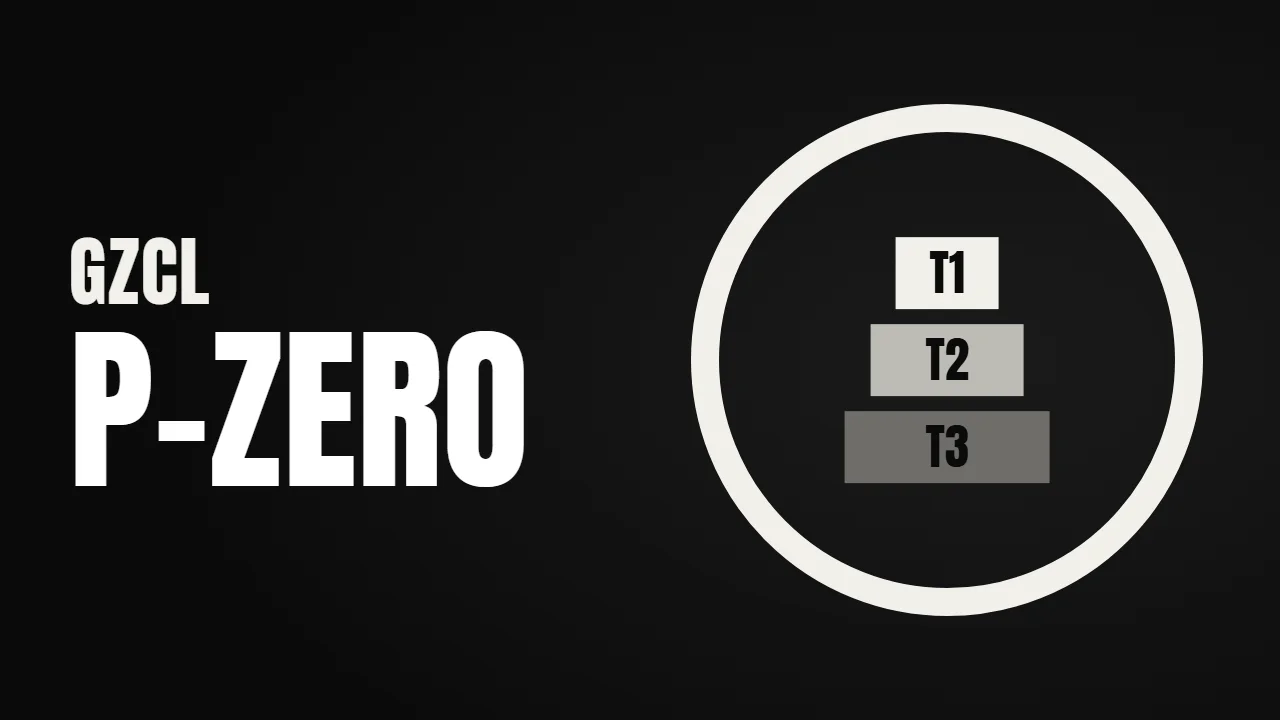
GZCL P-Zero, built for a strong press and bigger delts. Cody Lefever's own update to his GZCL method, from his book P-Zero: four workouts in turn, a rest day after each. The press is a T1 and a T2, and the T3s lean on pressing and raises. Every lift climbs three stages on its own. T1 is the day's main lift, 4 sets of 4 with the last for as many reps as you can, then 4x3+ and 4x2+. T2 is a second big lift, 4x12, 4x10, then 4x8. Four T3s finish each workout: 60 reps, then 45, then 30, in 2 to 4 sets. Add weight every session you make it; a miss moves that lift to its next stage.
Free to use · auto progression, rest timers & PR tracking built in
Cody Lefever
Cody Lefever is the creator of the GZCL Method and General Gainz training frameworks: a World Championship caliber lifter and coach, and a Marine veteran. Owner of Alma's Gym, North America's highest gym, he works with clients in person in Alma, Colorado and online around the world.
What is GZCL P-Zero · Shoulders?
P-Zero Shoulders is one of the four SLAB versions in Cody Lefever's 2025 book P-Zero: Revisiting the GZCL Method, his own update to the GZCL Method. In his words it is "for a strong press and delts": he has found that high volume helps both his pressing strength and the size of his delts. It keeps the full body version's tiers, stages and order of workouts and changes the lifts. T1 is the day's main lift, heaviest with the least volume; T2 is a second big lift, lighter with more reps; four T3s finish each workout, lightest and highest in volume.
There are four workouts, run in turn with a rest day after each: A1, B1, A2, B2. A1 is the overhead press (T1) and front squat (T2), then incline dumbbell bench, cable upright rows, one-arm cable lateral raises and face pulls. B1 is deadlift (T1) and bench (T2), then barbell rows, pec flys on the machine, incline dumbbell front raises and cable curls. A2 is squat (T1) and press (T2), then dips, Bradford presses, dumbbell lateral raises and lat pulldowns. B2 is bench (T1) and deadlift (T2), then a seated dumbbell press, rear delt flys, incline dumbbell curls and overhead cable triceps extensions. The press comes round twice, as a T1 and a T2, and so do the bench and deadlift.
Is GZCL P-Zero · Shoulders right for you?
Lifters who want a bigger press and more shoulder size, and who know the P-Zero rules or are ready to learn them. Cody suggests running this one in the winter and the arms version in the spring. Every T1 and T2 starts at 80% of a training max: 90% of a recent one-rep max for T1, 90% of a recent ten-rep max for T2, so you need a recent idea of both. You need a barbell, rack, bench, dumbbells, a cable station, a pec fly machine and a dip station. A session takes about 50–70 minutes.
How progression works
Every lift moves on its own through three stages. T1 is 4 sets of 4 at one weight, the last set for as many reps as you can (4x4+), then 4x3+, then 4x2+. A workout counts when that last set beats its reps by at least one, and then the weight goes up next time: 5 lb (2.5 kg) on bench and press, 10 lb (5 kg) on squat, front squat and deadlift. If you don't get the extra rep, the next workout moves you to the next stage, a step heavier. T2 is 4x12, then 4x10, then 4x8, with no extra reps on the last set: make every rep and add weight; miss one and move to the next stage, a step heavier. When the last stage fails, the lift starts again at its first stage, a little heavier than it started that cycle; Durata suggests one step up and lets you type any weight.
T3 stages are totals: 60 reps, then 45, then 30, in 2 to 4 sets, the first set the biggest. Make the total and the weight goes up a small step, 2.5 kg (5 lb); fall short and you move to the next total at the same weight; fall short of 30 and the lift starts again at 60 reps, a step heavier. Get about three quarters of the total in the first 2 or 3 sets and use the 4th to finish, with myo-reps (short 10 to 15 second pauses) when you need them. Dips start at bodyweight, logged as 0 added, and take weight once you make the stage. Rests are the top of Cody's ranges: 3 minutes for T1, 2 for T2 and 90 seconds for T3.
Durata runs this progression for you — there are no percentages to work out, so each session's target carries over from what you logged last time and the weight moves when you hit or miss the prescribed reps.
GZCL P-Zero · Shoulders — every set, every session
AMRAP = as many reps as possible on the final set.
A1 · T1 Press
| Exercise | Sets × Reps | Rest |
|---|---|---|
| Overhead Press (Barbell) | 3×4 1×4+ AMRAP | 3:00 |
| Front Squat | 4×12 | 2:00 |
| Incline Bench Press (Dumbbell) | 4×15 | 1:30 |
| Upright Row (Cable) | 4×15 | 1:30 |
| Single Arm Lateral Raise (Cable) | 4×15 | 1:30 |
| Face Pull | 4×15 | 1:30 |
B1 · T1 Deadlift
| Exercise | Sets × Reps | Rest |
|---|---|---|
| Deadlift (Barbell) | 3×4 1×4+ AMRAP | 3:00 |
| Bench Press (Barbell) | 4×12 | 2:00 |
| Bent Over Row (Barbell) | 4×15 | 1:30 |
| Chest Fly (Machine) | 4×15 | 1:30 |
| Incline Front Raise (Dumbbell) | 4×15 | 1:30 |
| Bicep Curl (Cable) | 4×15 | 1:30 |
A2 · T1 Squat
| Exercise | Sets × Reps | Rest |
|---|---|---|
| Squat (Barbell) | 3×4 1×4+ AMRAP | 3:00 |
| Overhead Press (Barbell) | 4×12 | 2:00 |
| Triceps Dip (Weighted) | 4×15 | 1:30 |
| Bradford Press (Barbell) | 4×15 | 1:30 |
| Lateral Raise (Dumbbell) | 4×15 | 1:30 |
| Lat Pulldown (Cable) | 4×15 | 1:30 |
B2 · T1 Bench
| Exercise | Sets × Reps | Rest |
|---|---|---|
| Bench Press (Barbell) | 3×4 1×4+ AMRAP | 3:00 |
| Deadlift (Barbell) | 4×12 | 2:00 |
| Seated Overhead Press (Dumbbell) | 4×15 | 1:30 |
| Rear Delt Reverse Fly (Dumbbell) | 4×15 | 1:30 |
| Seated Incline Curl (Dumbbell) | 4×15 | 1:30 |
| Overhead Triceps Extension (Cable) | 4×15 | 1:30 |
GZCL P-Zero · Shoulders — common questions
How is this different from the full body version?
Same tiers, stages, rests and order of workouts; different lifts. The press is a T1 in A1 and a T2 in A2, the front squat replaces the squat as a T2, and the T3s are mostly presses, raises and rear delt work, plus a barbell row, a lat pulldown, a pec fly, two curls and a triceps extension.
What weight should I start with?
80% of the lift's training max. For T1 that training max is 90% of a recent, technically sound one-rep max; for T2 it is 90% of a recent ten-rep max. Durata doesn't ask up front: the first weight you log on each lift becomes its starting weight.
How long should I run it?
Cody runs each SLAB version as a phase of 3 to 12 weeks, then moves to the next: Shoulders, Legs, Arms, Back, though the order is up to you. Switch under Your version on the program page.
What happens when I fail a lift?
That lift moves to its next stage, fewer reps a set: T1 from 4x4+ to 4x3+ to 4x2+, T2 from 4x12 to 4x10 to 4x8, both a step heavier, and T3 from 60 to 45 to 30 total reps at the same weight. Only that lift moves; every other lift carries on.
Is there an app that runs GZCL P-Zero · Shoulders for you?
Yes. Durata runs GZCL P-Zero · Shoulders as written, free: the 4-day-a-week schedule, every set and rep, and the progression built in. Log your sets and the next session's weights are worked out for you, with the stalls and deloads the program calls for; a tap on any lift shows why the weight moved. It is on iPhone and Android, works offline, and your history from Hevy or Strong imports free.
Source: P-Zero by Cody Lefever, from his book P-Zero: Revisiting the GZCL Method (2025)
With permission from Cody Lefever, who gave Durata permission to carry this program.
Run GZCL P-Zero · Shoulders in Durata
AMRAP tracking, automatic progression, plate calculator, rest timers and PR tracking — the whole program, ready to log.